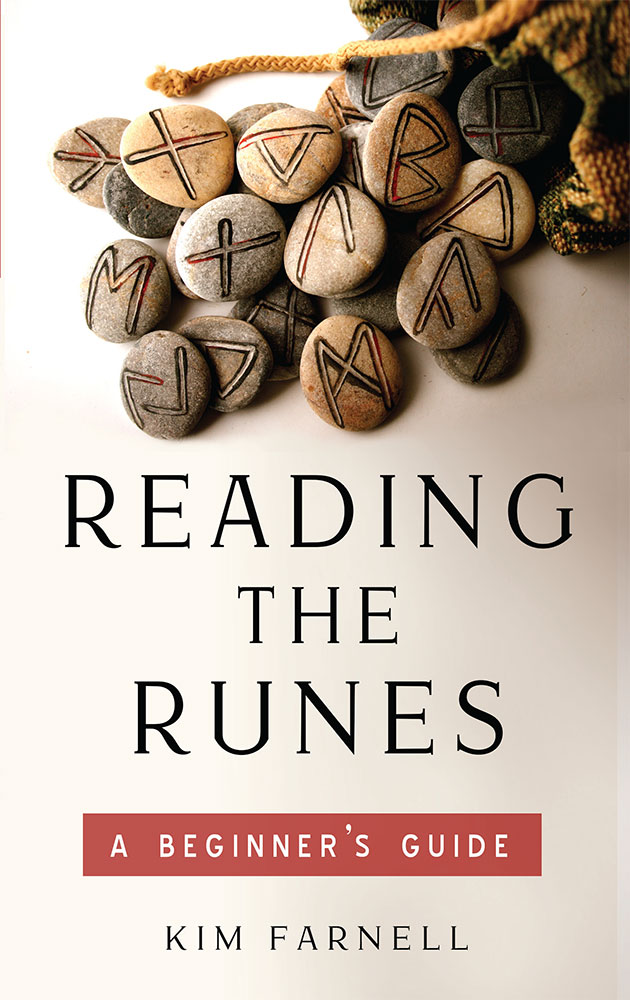
 Esoteric publishing is awash with beginner’s guides to the runes. Indeed, that neophytic designation is true of almost every popularly-published book about the runes, with advanced texts being few and far between. For some reason, Kim Farnell, and Red Wheel/Weiser imprint Hampton Roads Publishing Company, felt the world needed another one. From a mercenary publishing perspective, this is understandable because of the required minimum effort for maximum reward. It is a simple formula, one that we’ve seen here at Scriptus Recensera before: broadly introduce the runes, fill that page count with individual entries for each rune, maybe throw in some spread and exercises at the end, finishing off with some tables of correspondences to push the pagination to, in this case, 146 pages.
Farnell is an established author, with a significant body of work that principally considers astrology but also includes other forms of divination such as the I Ching. Bizarrely, this 2019 title isn’t her first beginner’s guide to the runes, with 2016’s Runes Plain & Simple, also published by Hampton Roads, and subtitled with the preposterous claim to be The Only Book You’ll Ever Need. That title was a new edition of Simply Runes that was published by Sterling in 2006 and has since been republished again by Hampton Roads in 2024 as Runes: An Introduction, and may be the same as the 2016 Runes, published as part of Orion Publishing’s Plain and Simple series. Given that those books are based off the same 2006 or earlier manuscript-that-keeps-on-giving, constantly cycling through editions and titles, one wonders how different that rudimentary text is from the content of this book. There is certainly a clunky, redundant quality to the writing that suggests an ur-text that has been tweaked over time without a proper editorial overhaul, but then this could just be the writing style.
Despite the extensive (though possibly recycled) bibliography, Farnell’s writing lacks finesse and flow, often consisting of paragraphs of sharp, staccato sentences that do not connect with their fellow constituents. One paragraph, chosen at random, contains eight sentences, with one of those consisting of just ten words, creating a stop-start statement-stabbing motion when reading. And then there’s the less than convincing history Farnell provides for the runes, flitting all over the place geographically and temporally, broadly mentioning things that often fail to ring true, as if she is misremembering half-heard facts or writing a book report about a title she’s never read. It all gives the sense of a subject matter that one is not familiar with, dropping names but not knowing the context; which is then compounded by the lack of references. She says “Anglo Saxons are credited with spreading the runes throughout Europe” without explaining who credits them with this, or even how it would work, with these English orthographers undertaking proselytising tours of the continent. She describes Óðinn as the father of creation, despite Norse cosmology being autogenous and Óðinn himself being a product of that process. She conflates the use of rune to refer to Germanic runic letters with references in which the word is clearly used to mean any magical symbol, imagining that Kramer and Sprenger in Malleus Maleficarum are talking about witches using runic letters, or claiming without evidence that “the magician John Dee worked with runes.” Inexplicably, she writes that in 1937, “runes gained ground in the UK with the publication of J.R.R. Tolkein’s The Hobbit,” as if the subtle use of the futhark on the book’s dustjacket kick-started some sort of runic revolution.
Finally, there’s the bizarre claim about the survival of runes in Iceland when in chapter two Farnell writes “As Christianity spread into the northern realms, the development of the Nordic mythologies began to fade. However, the Vikings colonized Iceland where Christianity had a much weaker influence.” Overlooking the fact that the word ‘vikings’ refers to what were effectively Scandinavian pirates and not the general populace, Farnell seems to imagine a weakly Christian Iceland being invaded by pagan ‘vikings’ from, I guess, an ahistorically still-pagan Norway, which made it “possible to preserve the pre-Christian myths” when they were written down for the first time. For the record, the previously unpopulated Iceland was first colonised in the 9th and tenth century CE by pagans from Scandinavia and, perhaps surprisingly, the Irish and British Isles, and the country converted to Christianity in 1000 CE when the Althing declared it the official religion. Perhaps the whole thing was just poorly worded on Farnell’s part, but what really draws attention to it is that she brings it up again in chapter three, confirming the general fallacy by writing “With the Vikings colonizing Iceland, which was less influenced by Christianity, their ancestor’s religion was preserved.” Giving that the man credited with this scriptural preservation, Snorri Sturluson, was born 179 years after Iceland’s official conversion to Christianity, this doesn’t make a lick of sense.
Farnell’s potted history of the runes ends in the modern era where she mentions their mass-market popularisation by Ralph Blum and his introduction of the ahistorical blank rune, adding a little dig by saying “many regard it as showing a misunderstanding of the runes and upsetting their balance.” Naturally, we don’t know who these ‘many’ are, but take that Blum! Actually… forget that, because when it’s time to list all the runes, Farnell goes and puts the blank rune in there anyway, sticking it at the end and giving it the typical fallacious association with wyrd.
It is funny that Farnell should mention Blum because her grasp of runic history seems as broad and unspecific as his, or rather, much of this history is his. On the first page of her second chapter, she writes “When the high chieftains and wise counselors of Anglo-Saxon England met, they called their secret deliberations “Ruenes.” When Bishop Wulfila made his translation of the Bible into fourth century Gothic, he rendered St. Mark’s “the mystery of the kingdom of God” using the word “runa” for “mystery.” With the exception of a few edits and the misspelt and meaningless word ‘ruenes’ (possibly the result of poor transcription or bad OCR process) this is almost word-for-word transcription of a paragraph from page 17 of Blum’s 1985 Book of the Runes in which he paraphrases, and, to his credit, cites, Ralph W. V. Elliott. Blum then continues, talking about Herodotus’ encounter with Scythian tribes who cast sticks for divination, and what do you know, Farnell does the same, copying and pasting with a couple of superficial edits, but leaving in a lot of Blum’s original sentences, including quite idiosyncratic phrasing like “crawled under blankets, smoked themselves into a stupor.”
Anyway, as to the rest of the book, Farnell puts off giving the standard list-the-runes/give-each-one-a-blurb and instead spends the page space on assigning deities to them, handily taking up eight pages. Some of these associations make sense given their names (Tiwaz was always going to be Tyr) but just as many are arbitrary or a bit of a stretch. Things get super stretchy by the end of the futhark when Dagaz is assigned to Ostara, who Farnell defines as one of the Vanir, despite her being merely a theorised continental goddess for whom mere evidence of existence is lacking, let alone anything that would attest to her being someone who “is a friend to all children, and to amuse them she changed her pet bird into a rabbit. The rabbit brought forth brightly colored eggs, which she gave to the children as gifts.” There’s a lot of doubling up here, so some deities are assigned to multiple runes, and here, once again, Farnell’s reliance on shortcuts raises its head as she cuts and paste the very same descriptions of each deity, word for word; and often within pages of each other so that it’s impossible not to notice.
Nine pages are handily consumed by reprinting the various rune poems, sans any commentary or insight. Then a chapter on making your own runes manages to pad some more by giving an extensive listing of types of wood to use, along with lots of unverifiable folklore and mythological claims, my favourite being this canard: “In Norse mythology, the Goddess Freya chose the black elder as her home.” If only a source for such a claim existed somewhere. Oh wait, it does, a page on a now defunct website tarahill.com, online since at least 1999, which, wouldn’t you know it, contains the same list of trees with almost the exact wording for each entry; and which explains why, in her entry for the alder, Farnell suddenly mentioned Bran as if we should know who that Welsh mythological giant is.
At page 61, we finally arrive at full considerations of each of the runes, followed by some divination spreads. This is all the typical stuff, an origin, a contrived positive oracular interpretation, and the corresponding negative or reversed import. Given the track record established by the book, these all probably come from somewhere else, cut and pasted with a little tweaking for barely plausible deniability. The spreads, at a cursory look, are indebted to Blum, which is once again unsurprising.
Writing is inconsistent throughout Reading the Rune and without a bibliography at the back, or far too much time on one’s hands, it’s impossible to know if this is because even more of its contents have been lifted from other writers, What can be said though is that there’s a general sloppiness to it all, whether that’s simply from carelessness or from the aforementioned lack of thorough understanding. Spelling errors abound, with Bestla losing her ‘l’ in one instance, Surtr being rendered as Sutr, Hvergelmir being reassembled as Hvregelmer, Yggdrasil becoming Yggadrasil over the course of one paragraph, and the collective plural of Æsir being given as Aesirs, shudder.
Thoroughly impossible to recommend and shockingly brazen in its plagiarism, Reading the Rune is proof that we don’t need any more introductions to the runes, it’s all been written before and in the case, and cut and pasted into this sorry tome.
Published by Hampton Roads Publishing Company