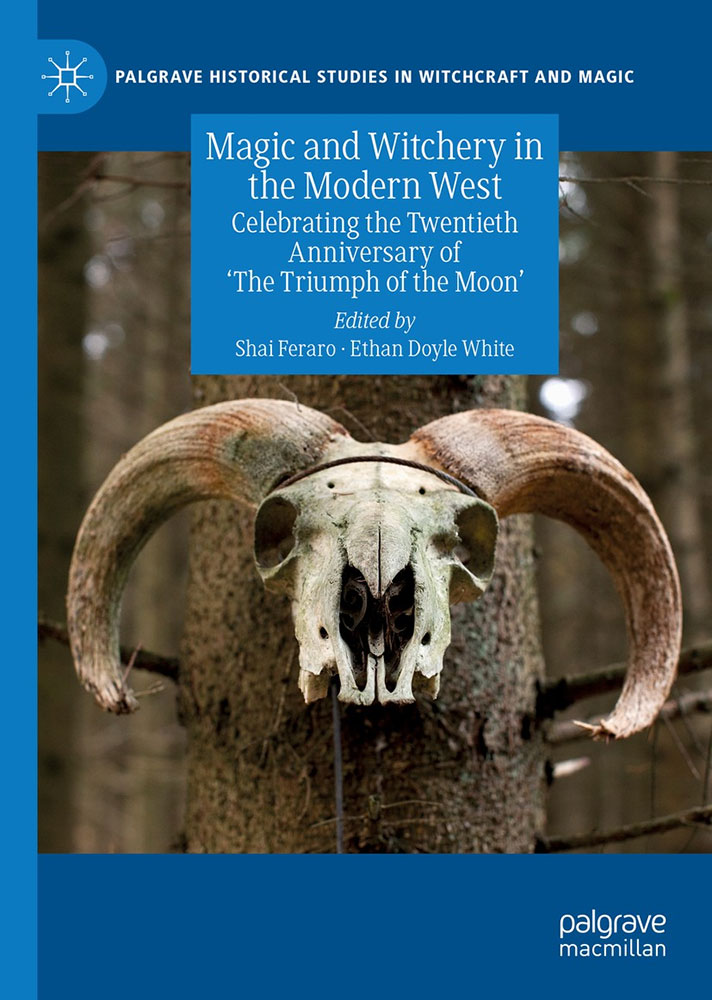
 Part of the Palgrave Historical Studies in Witchcraft and Magic series, this anthology published in 2019 celebrates the then twentieth anniversary of Ronald Hutton’s seminal study of modern Wicca and witchcraft, Triumph of the Moon. With great affection, editors Shai Feraro and Ethan Doyle White acknowledge the impact of that book and the debt owed to Professor Hutton whose work inaugurated wholly or partly the now vibrant field of contemporary esoteric studies. Contributions are provided by Hugh B. Urban, Helen Cornish, Jenny Butler, Sabina Magliocco, Sarah M. Pike, Léon A. van Gulik, Manon Hedenborg White, and Chas S. Clifton, as well as editors Feraro and Doyle White, whilst the esteemed professor himself wraps everything up with an afterword.
In The Goddess and the Great Rite: Hindu Tantra and the Complex Origins of Modern Wicca Hugh B. Urban takes a road less travelled in the consideration of the core influences in the formulation of modern Wicca. Rather than the usual nods to ceremonial, Urban turns to the then growing interest in Eastern mysticism and especially tantra, notably the works of Sir John Woodroffe, aka Arthur Avalon, whose ground-breaking translation of core tantric texts introduced them to the West and made them accessible to anyone within the esoteric milieu. Urban draws particular attention to Avalon’s 1918 work Shakti and Shakta, in which he describes the chakra puja, a circular ritual that ultimately resembles Gerald Gardner’s Wiccan Great Rite: an identification of the priest and priestess with the male and female deities, the organising of participants in a circle of alternating genders, and the central role of transgressive practices (the apex being ritual sexual union). As Professor Hutton points out in his afterword, the influence on tantra on nascent Wicca was a filtered one as it came not via direct encounters with the original texts, but through the guiding pen of Arthur Avalon. Recourse to such a mediating function was a feature, not a bug, in the foundation of Wicca, with information being sieved through literary filters, be they Margaret Murray’s witch cult hypothesis (rather than direct witch trial records), or as is discussed in later entries, conceptions of nature, or fairies, both of which were indebted to Romantic idealisation of a pagan past set against an industrial future.
Whilst the majority of entries in Magic and Witchery in the Modern West approach their theme via words, be they source texts or interviews and survey results, Helen Cornish provides arguably the most interesting contribution here by turning to objects. In Other Sides of the Moon: Assembling Histories of Witchcraft, Cornish considers witchcraft’s reappraisal of itself and its history in the wake of Hutton’s Triumph of the Moon, coming to reprioritise the physical evidence of yesteryear’s cunning folk and folk magic over the largely baseless and wishful theoreticals of Murray and Gardner. The principle site of this ethnographic appraisal is the Museum of Witchcraft and Magic in Boscastle, particularly its Wise-Woman’s Cottage exhibit which features a wax mannequin representing a nineteenth century wise woman, Joan, her idealised occult expertise and reputation made real as she sits at the table in front of the fire, surrounded by the tools of her trade. Cornish notes the impact this tableaux has on observers whether they have an occult affiliation or not, but for those identifying as witches this is made stronger by the way in which her tools and just vibe align with their own praxis, being “met with emotional senses of recognition by many visiting witches, especially those who see themselves as inheritors of these traditions.” In searching for meaning and antecedents in the objects of past cunning people who would have had wildly different beliefs to them, modern pagan witches feel little different to pre-Hutton believers in Gardner’s witch cult, but Cornish is never overtly judgemental in her assessment, keeping an anthropological realness if you will.
Playing the Pipes of PAN by editor Feraro explores the anti-nuclear group Pagans Against Nukes and the intersection of Wiccan-derived paganism with Ecofeminism in Britain, 1980–1990. Being somewhat Feraro’s academic focus, and a relatively obscure one at that, this is a subject also explored in his later book Women and Gender Issues in British Paganism, 1945–1990, the review of which notes the indebtedness to this essay. The theme of the environment is also considered in Sarah M. Pike’s Wild Nature and the Lure of the Past: The Legacy of Romanticism Among Young Pagan Environmentalists. Pike builds on one of Hutton’s core themes in Triumph of the Moon, the considerable influence of early nineteenth-century English Romanticism on what would become modern witchcraft. Essentially, the Pagan revival was part of Romanticism, indebted to its belief in an idyllic pagan past and a personification of the divine in nature that stood in contrast to the world’s burgeoning urbanisation and industrialisation. Pike traces this legacy into contemporary environmentalism which can often have a pagan veneer, either because participants are capital ‘P’ Pagans, or lowercase pagans who simply have an affinity with paganism as a broad counterpoint to ideas Capitalist, Christian and Imperialist. Pike gives a brief history of environmental Paganism, with Starhawk and the Church of All Worlds as the movement’s twin primum movens, before calling on her own research amongst contemporary environmental protesters.
Sabina Magliocco follows a somewhat similar approach to Pike, taking, as her starting off point, Hutton’s thesis concerning the relationship between literary and oral tradition, and exploring how the twelfth and the seventeenth century proliferation of works about fairies influenced how they were perceived in the popular imagination; a perception ultimately owing as much to literature as it did to oral tradition. In The Taming of the Fae: Literary and Folkloric Fairies in Modern Paganisms, Magliocco extends this consideration into the modern pagan revival, arguing that that modern Pagan conceptualisations of fairies is heavily influenced by the ways in which they were imagined by the Victorians and Edwardians, ultimately resulting in belief in a race that is tamed and approachable, even affable, rather than wild, inscrutable and capricious. Using surveys from pagan respondents who claim interactions with the fae as children, Magliocco shows how the conception of these fairies has been irrevocably shaped by such literary precedents as Tinkerbell from J.M Barrie’s Peter Pan, and Cicely Mary Barker’s Flower Fairies series of illustrated books, with an emphasis on childlike and diminutive magical playmates. The idea of fairies as elemental guardians of nature also have literary antecedents, with Magliocco highlighting how this topos of the fae as an antidote to the Entzauberung afforded by urbanisation and industrialisation, was established by Rudyard Kipling’s Puck of Pook’s Hill and the William Besant and James Rice novella Titania’s Farewell, both of which deal with the fae leaving England due to being fed up with changes. There’s an interesting process at play here, with the disenchantment of the modern world being course corrected by a romanticism that elevates the fairy, and yet the process of taming the fairy in order to facilitate this, making them friend rather than fiend, is itself a result of the same disenchantment.
In the closing trio of entries to this anthology, the focus turns away from specifically Wiccan interpretations of witchcraft to other, usually darker hued, occultists who have embraced the designation of witch. Manon Hedenborg White explores what she defines as the Post-Thelemic Witchcraft of Jack Parsons and Kenneth Grant in The Eyes of Goats and of Women. Beginning with a brief survey of references to witchcraft amongst Crowley’s oeuvre, effectively providing context within which Parsons and Grant sit, Hedenborg White then gives an overview of Parson’s Babalonian-themed witchery, identifying its core anti-authoritarian theme as one of female liberation, a proto-feminist, nature-romantic worldview that foreshadows “later articulations of feminist witchcraft in the 1970s and 1980s.” Hedenborg White draws attention to some of Parsons’ literary influences, merging Crowley’s prose with Romantic and Gothic antecedents, as well as, potentially, pulp author Jack Williamson’s 1948 novel Darker Than You Think and the weird fiction of R. W. Chambers. The same confluence of the occult and fiction is found in Kenneth Grant, as is the use of the figure of the witch as a sex and female positive interpretation of magic, in a “systemic critique of perceived androcentrism within Crowley’s sexual magic.” Hedenborg White credits much of Grant’s interpretation of witchcraft as coming from Austin Osman Spare, but regrettably she doesn’t spend too much time on this, or on Grant in general compared to Parsons.
Ethan Doyle White’s dark witchery person of interest is Andrew Chumbley, founder of the Cultus Sabbati whose influence on modern strains of traditional witchcraft stands in contrast to his relatively short life. In Navigating the Crooked Path, Doyle White provides a comprehensive biography of Chumbley, pulling together seemingly everything that is known about him, documenting his involvement with other occultists and organisations, and gently prodding around his influences and self-myth-making. Up until now, the best concentrated discussion of Chumbley was, perhaps, the chapter on the Cultus Sabbati in Children of Cain by Michael Howard (a Cultus initiate and friend of Chumbley’s), but Doyle White has taken that crown, and this entry alone makes this book worthy of procurement.
Chas S. Clifton brings this triad of traditional witchcraft to a close with Witches Still Fly: Or Do They? Traditional Witches, Wiccans, and Flying Ointment, in which he positions the idea of entheogen use, particularly the flying ointments of witches, as a totem for those calling themselves traditional witches. Clifton argues that the embracing of entheogens as part of witch praxis enables self-identifying traditional witches to mark themselves as distinct from the more straight-edge Gardnerian Wicca for whom flying ointments are only briefly mentioned. Clifton uses three people as exemplars of this traditional witchcraft wing: Robert Cochrane (leader of the Clan of Tubal Cain), Michael Howard (editor The Cauldron magazine for 39 years) and Peter Grey (one of the founders of Scarlet Imprint Press and the author of Apocalyptic Witchcraft). Clifton takes a pretty cynical approach to all this, ultimately labelling claims to familiarity with flying ointments as a type of ‘secretism,’ employed by traditional witches wishing to be seen as having secrets that only they are privy to, thereby engendering kudos and respect within the occult milieu. It’s a valid point, but Clifton does lay the snark on a bit thick at times (rich coming from this reviewer), going so far as to spend half a page reprinting part of Seth David Rodriguez’ blogpost How to Be a Traditional Witch on the Internet, which just gives vibes of an excited boomer reposting on Facebook.
In all, Magic and Witchery in the Modern West makes for a fun read, with a variety of entries that ensures everyone should find something that aligns with their favourite kind of witchery.
Published by Palgrave Macmillan