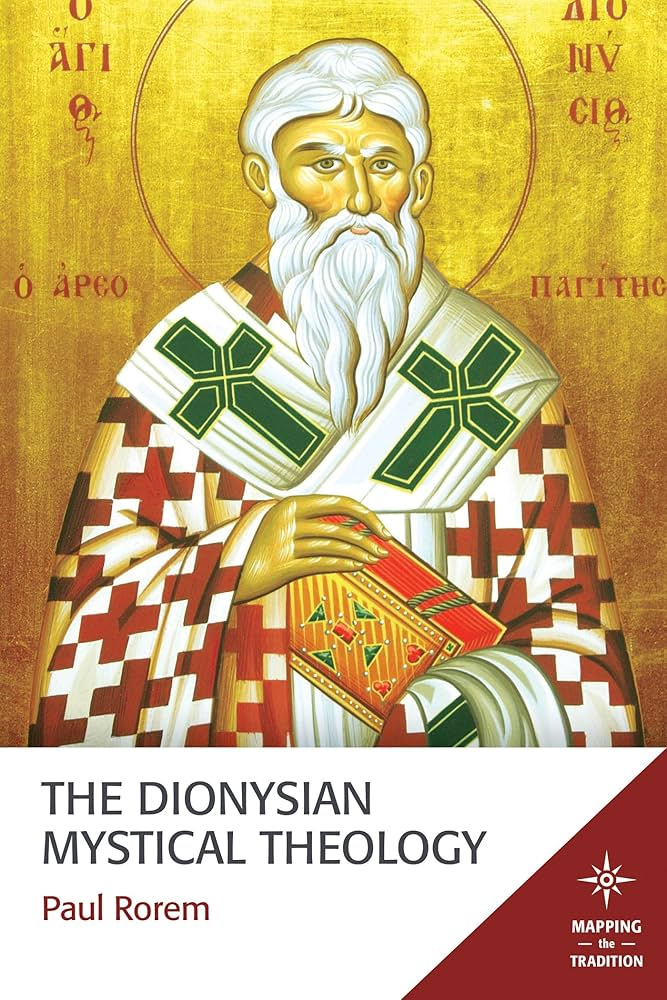
 Paul Rorem is the series editor for Fortress Press’s Mapping the Tradition, a collection of compact guides to pivotal thinkers in Christian history, divided into eras of Early Christianity, Medieval, Reformation, Early Modern and Modern. Part of the Early Christianity grouping alongside works on Irenaeus of Lyon, Athanasius and John of Damascus. The Dionysian Mystical Theology is Rorem’s contribution to the series, providing an overview of Pseudo-Dionysius the Areopagite and his apophatic mysticism.
The unknown author referred to as Pseudo-Dionysius was a late fifth and early sixth century CE theologian who wrote under the guise of the first century CE St. Dionysius the Areopagite, a member of the Athenian judicial council whose conversion to Christianity by St. Paul is described in the Acts of the Apostles. Rorem draws attention to the events surrounding this conversion, and how it was initiated by Paul’s sermon in which he remarked on an Athenian statue dedicated to the Unknown God, effectively identifying this Agnostos Theos with his god, whose name was forbidden to be said. Centuries later, this story provided a fitting hook, as Rorem terms it, for the adopted name of the author and its intersection of themes around Neoplatonist ideas of divine knowability and unknowability.
Rorem divides his book into two parts, first providing an overview of Pseudo-Dionysius’s cosmology and apophatic theology using the Areopagite’s own miniature essay, The Mystical Theology, progressing through each statement with commentary. The Mystical Theology is very much a condensing of the ideas in Dionysius’s longer works, and is used here as a particularly good example of his incorporation of negations in an apophatic theology that recognizes the transcendence of God beyond human words and concepts, seeing God in the absence and darkness. Each of the three chapters of The Mystical Theology are analysed section by section with extensive notations.
In the second part of this book, Stages of Dionysian Reception and Interpretation, Rorem turns to discussing how Dionysian thought has been received and interpreted by theologians and church historians, compiling four previously published essays. As this body of work would suggest, this is not Rorem’s first Pseudo-Dionysian rodeo, having, in addition to such essays, written a significant commentary on the corpus, published by Oxford University Press in 1993, and with John C. Lamoreaux translating the Dionysian scolia of John of Scythopolis, also published by OUP under the Clarendon Press imprint as part of their Oxford Early Christian Studies series. Prior to that, in 1980, a sprightly Rorem completed his doctoral dissertation on the Pseudo-Dionysian Synthesis, which was then published in 1984 as the book Biblical and Liturgical Symbols within the Pseudo Dionysian Synthesis by the Pontifical Institute of Mediaeval Studies at the University of Toronto.
In the first of these essays, The Doctrinal Concerns of the First Dionysian Scholiast, originally published by Études Augustiniennes in their 1997 Denys l’Aréopagite et sa postérité en Orient et en Occident, Rorem begins with the Byzantine theologian, lawyer and bishop John of Scythopolis whose most significant contribution to early theology was the penning of several works, now lost, in opposition to the Monophysite heresy. Bishop John, writing a mere generation after Pseudo-Dionysius, composed an extensive set of scholia to his predecessor’s works, prefaced by a long prologue in which he set out his reasons for commenting on the corpus, principally as a defence against the Apollinarism and Eutychianism forms of Monophysitism. Using minute points of grammar, vocabulary, and biblical sources in his comments on the Dionysian corpus, John affirms that Christ assumed an earthly body and a rational soul, against Apollinaris and other Monophysites, and that final salvation is of the soul and the body.
The second chapter, The Early Latin Dionysius: Eriugena and Hugh of St. Victor, was originally published under a slightly different title in Modern Theology (2008) and also a year later in Wiley-Blackwell’s anthology Re-thinking Dionysius the Areopagite. Here Rorem considers the exposition and appropriation of Pseudo-Dionysius’s work in ninth and twelfth century Western Europe, where the Areopagite was conflated with a third century local saint, the cephalophoric St Denis of Paris. For those looking for responses to apophatic theology, there’s little here, with Pseudo-Dionysius instead being called upon for his role as a, as Hugh describes him, “theologian and describer of the hierarchies,” with few traces of Dionysian influence being found in his work.
In Martin Luther’s Christocentric Critique of Pseudo-Dionysian Spirituality, previously published in Lutheran Quarterly 11 (Autumn, 1997), Rorem very much enters his Lutheran wheelhouse, turning to the theologian who dismissively referred to “Dionysius ille, quisquis fuerit” (‘that Dionysius, whoever he was’), describing him as pernitiosissimus (‘most pernicious’). The practical Luther was dismissive of Pseudo-Dionysius’s idle speculation about celestial hierarchies, calling his “hodge-podge about angels” dangerous and accusing him of being more a Platonist than a Christian; not an unfair assessment, if a little mean. The same was true of Luther’s approach to apophatic theology, countering the Areopagite’s vision of the darkness of God with an incarnational theology of the cross in which God is hidden, concealed in the darkness of humanity, where he could not be seen but only heard.
Finally, in Negative Theologies and the Cross, Rorem delineates the intellectual legacy of apophatic thinking, dividing it into a triad of streams: the progressive apophatic, the complete apophatic, and the incarnational apophatic. First published in Harvard Theological Review 101 in 2008, and then reprinted a year later in Lutheran Quarterly, this expands on the previous chapter, comparing Luther’s interpretation to others which centre Christ, the incarnation, and the cross. The progressive apophatic is based on Exodus 33, with its imagery of Moses ever advancing morally and spiritually by following the hidden God in everlasting time, with negations lead to more negations. The complete apophatic understands Sinai’s darkness of unknowing as a mystical union with God in ecstatic eternity, with negations leading to a union with God. Finally, the incarnational apophatic explicitly turns from such Sinaic darkness, following John 1 and Philippians 2, to the incarnation and cross of Christ in salvation history.
Due to the nature of the format as a compact overview, with a page count of a mere 141 pages, there’s a feeling that Rorem races along, never dwelling on anything for too long, brevity trumping considered reflection. While he is a largely impartial presenter, it is clear that Rorem favours incarnation over negation, and there are multiple moments in which he comes across as flabbergasted with Pseudo-Dionysius’s apodictic embrace of the apophatic, palpably telling him off back down through the centuries. Despite having written so extensively on Pseudo-Dionysius throughout his career, there is no sense of Rorem merely regurgitating what he’s previously written and augmenting it with a couple of editing changes. Even the straight-up textual analysis of the corpus in the first half of this book, which clearly mirrors, by its very nature, some of the content in his 1993 A Commentary On The Texts And An Introduction To Their Influences, by no means feels beholden to that ur-text. There are some limitations in the consideration of the broader influence of Pseudo-Dionysius’ apophaticism, borne out Rorem’s status as a Lutheran theologian, where the historical trail ends with Luther and the strain of negative theology within Dominican mysticism. In his closing sentence, Rorem underscores what might have been, bowing out and leaving more suitable others to consider what modern and postmodern minds make of Dionysian apophaticism. He does give a few suggestions, referring to philosophers such as Emmanuel Levinas and Jacques Derrida, as well as from the theological side of the aisle, Swiss theologian Hans Urs von Balthasar.
Published by Fortress Press